Kogarg
 The kogarg are a birdlike race of people who originate from the more clement environments of the Rendi, leaving them with little tolerance for harsh weather. They are one of the many races born from the Rendi sisters, with their ancestor Tres having moulded their first eggs from the clay of Demrefor’s caves.
They are a naturally curious people and it shows within their culture; questions are never discouraged and education is considered as important a right as food and water. Because of this kogarg are often stereotyped as being intelligent or scholarly, though most will reassure they are only as intelligent and friendly as any other Sentient.
Physical Traits
 Av. Height (Male): 5’9”
Av. Height (Female): 5’11”
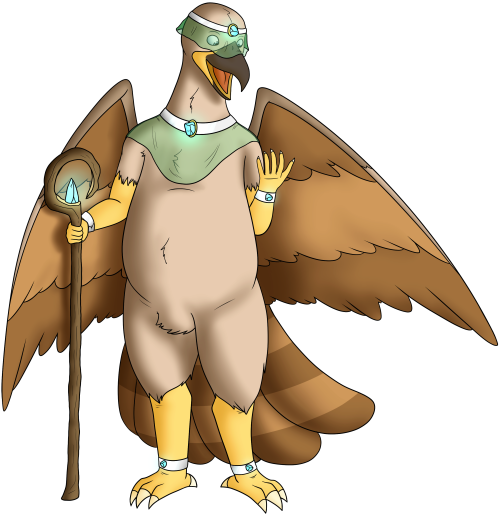
The tallest of the Rendi races, kogarg are feathered humanoids with six limbs; having all a pair of legs, arms, and wings. Their legs and arms are bald and scaly from the shoulders and knees down, and their skin may be a variety of colours, ranging from dark greys and browns to bright yellows and oranges.
Their legs are more digitigrade than most other Sentients, with their feet being sharp talons. Different kogarg find different styles of walking comfortable; with some preferring to stand flat-footed, and others preferring to be toe-walkers. Their hands are somewhat similar to their talons with claw-like nails and each digit’s joins having a pebbled look to them.
Their feathers can be a variety of colours and markings, with nearly any combination imaginable. These feathers are coated in an oil that slicks them down, making them look smooth and somewhat shiny in appearance. This oil protects them from magical residue, even being soulstone resistant as oil-coated feathers take over twice the time to be damaged by soulstone as regular feathers.
Just as their skin and feathers can be varied, so can be their beaks. They can have any type of beak; long or short, pointed or curved, crushing or sharp. The only consistency found on all kogarg’s beak is their flange, as the corners are flexible and able to create complicated complex expressions.
It is said that, if a bird exists, there is probably a kogarg who resembles it. This is especially noticeable with their wings and tails. Kogarg with markings or beaks that resemble wild birds will also often show similar wing and tail configurations, sometimes even sporting extra crests, tufts, or ruffs to match.
Though kogarg can have a large amount of variety in their features, their genetics tend to be rather complicated, with the way they inherit their features often compared to the way the genetics of a domestic cat work. It is not uncommon for a kogarg child to resemble only one parent and not another, with siblings that look nothing alike.
Sex and Gender
There is very little in the ways of sexual dimorphism between male and female kogarg. At most, some colour or marking variation may be present amongst immediate family members, but overall there is not much of a way to tell a kogarg’s biological sex without an invasive inspection of their internal genitalia.
As most parents would rather not perform invasive inspections on their children unless completely necessary, to avoid the risk of both physical and mental trauma, it is much more common for kogarg to be raised in gender-neutral environments. Children are encouraged to experiment with their pronouns until they find ones they enjoy using most, and may continue to change these pronouns throughout their lifetime.
Most kogarg don’t learn their biological sex until they are sexually active; though it tends to have very little effect on their personal gender identity. It is considered a private thing only shared with medical professionals and partners.
The genitalia of a kogarg is, mostly, very similar in appearance between sexes. Both sexes have a cloaca-like slit, though it differs from a true cloaca as it is separate from their digestive tract. Instead they refer to their genitalia as their “krisk.” The krisk of a kogarg is shallow and sensitive, with most of their nerves being close to external as, unlike most other Sentients, male kogarg have no penis and cannot penetrate their partners. Instead, they and their partners rely on external friction. Most kogarg avoid any sort of penetration doing intercourse as, because of how their anatomy works, they generally find the sensation more uncomfortable than stimulating.
This lack of penis is what makes identifying the sex of a kogarg so invasive; though the fluids male and female kogarg produce are different in texture and can be used to sex them, unless they are sexually stimulated the only other way to confirm their biological sex is to physically feel around the very backs of the krisk for lumps indicating testes.
Common Disabilities and Health Issues
Oil Gland Issues
A common health issues kogarg face are issues with the oil glands that are supposed to coat their feathers. In a healthy kogarg, the oil that covers their feathers is excreted directly from the follicle and, during bathing, soaks into the feathers. However, there are many things that can affect these glands and the oils they secrete, meaning that this process fails or feathers are left damaged.
Most often, these issues are caused by hygiene problems or incorrect soap usage. Refusal to bathe for extended periods means the oils build up and congeal, blocking the oil glands. And certain shampoos and soaps that are common-use in other Sentient cultures can strip away the protective oils and dry out the feathers to the point they struggle to absorb a new layer of oil until their next moult.
Issues with glands can also be caused by inherited genetic conditions, or by physical scarring to the follicles after injury, surgery, or feather-plucking.
Spraddle Leg and Foot Deformities
Leg issues are relatively common in young kogarg, though with early intervention and proper treatment most issues can be either resolved or adapted to before adulthood.
In conditions involving bowed legs or muscular issues, leg braces are used to correct posture. Mostly, as a kogarg grows, these braces will help correct the growth patterns of their legs and they will be able to eventually live without them. However, this is not the case for all kogarg, especially those with other co-morbid issues such as problems absorbing calcium or vitamin D, and some may find themselves living with supportive braces their entire life.
Depending on the severity and cause of the condition, medication may be needed; as well as other mobility devices such as canes, walkers, and crutches may also be used during treatment.
Often connected to bow-leg conditions are foot deformities, where the toes of a kogarg’s foot don’t develop or separate properly as individual digits, causing issues with balance. Kogarg born with foot deformities are generally able to adapt well to prosthetic aids, however, and find it rarely affects their overall quality of life.
Choanal Atresia and Chronic Nasal Discharge
Sometimes referred to as “beak block” in layman’s tongue, this condition is rare but generally severe in those it affects. It is a birth defect affecting the nasal passage where bone, tissue, or keratin develops wrong and partially blocks the airway.
Often accompanied by deformities of the nasal bridge or beak, ranging from uneven growth in childhood to the complete lack of nostrils on hatching, this condition poses a high risk of infant mortality if not immediately treated as newly-hatched kogarg may struggle to take in enough air.
The exact causes of this condition are unknown, but it is often attributed to humidity or temperature issues during late-stage incubation.
Relationships and Life Stages
Friends to Marriage
Polyamorous by nature, kogarg tend to have between 3-5 partners within a closed relationship. These relationships will start out as a friend group; every kogarg will be in several different friendship groups that they will spend time with regularly, with one of these friendships eventually developing a non-platonic dynamic that will turn into a complex romantic relationship involving the entire group. Once a group of friends begins to develop a romantic dynamic, they will refer to themselves as a “flock.” This change of dynamic tends to happen over several years, at a comfortable pace, until a flock find themselves living together in one home and potentially looking to start a family.
Despite kogarg relationships beginning as friendships, they do not see their flocks as “more” than their other friendships; instead, they view romance as one of many different potential friendship dynamics that can naturally develop over time, and believe them no more or less important than platonic relationships.
There are no true traditional dynamics in a kogarg relationship; as the relationships develop over time in a very intimate environment, each group of partners find themselves with very unique relationship styles and setups tailored specifically to their own flock.
All kogarg in a flock should be within the same age bracket; though there are some exceptions to this, and it is not illegal to have flock with age gaps provided all involved are adults, it is not socially acceptable in kogarg culture for the eldest and youngest members of a flock to have an age difference of more than 5 eclipses apart.
Life Stages
 Most kogarg children are unplanned; simply being a natural result of a relationships if those within it do not actively choose to use birth control. A non-mammalian peoples, kogarg do not produce milk and instead lay eggs. These eggs are small, able to be held safely in one hand, have an unusually circular shape, and a brown-coloured shell with a texture similar in feeling to dried clay.
A kogarg will lay their eggs about a month after conception, with 6-10 eggs within a single pregnancy. These eggs can all be fertilised by different fathers, and as kogarg are polyamorous it is considered rather unusual when all children in a clutch only resemble one male parent.
It takes 10 months for a clutch of kogarg eggs to hatch and are usually incubated in baskets or cradles using warm water bottles or packs of heated wheat. Though most flocks will not try for a second clutch during these months of incubation, it is not unheard of for some families to have up to thirty eggs incubating at the same time. Though, to total more than thirty children in a single family is considered strange and inconsiderate of the children’s needs.
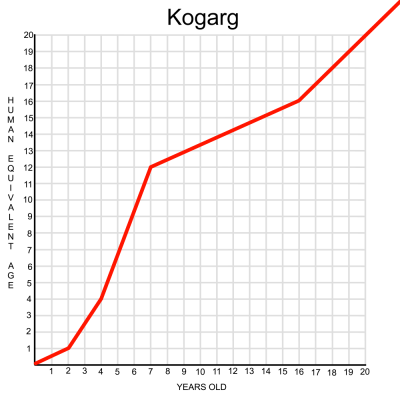
When kogarg first hatch they are very small, fragile, and bald; needing constant care and attention. They are not able to regulate their own body temperatures nor eat without help until they are nearly 2 eclipses old. Because of this, caring for them is very draining and seen as a full-community responsibility. Every member within a flock will take on equal roles in looking after their children, and kogarg parents will take their eggs and children with them when spending time with friends outside of their flocks. Their friends will help them care for their children while together, and if more than one member of a friend group has children this care provides their young children opportunities to socialise and create their first friendship groups together.
Once a kogarg reaches 2 eclipses, their development begins to quicken, with the first signs of their down growing in, and they are considered toddlers until they turn 4. Development during this time is different for each individual, with some quicker than others, but by the time they are 4 they will have learnt how to walk and run, speak in small sentences, use utensils such as forks or pencils, dress themselves with minimal help, and count to at least 10. They should also have their full-body down completely developed by this time.
Once a kogarg hits 4 eclipses, they have a major growth spurt; developing from toddler-hood all the way into pre-puberty in only 3 years. Because of the speed of this growth, most kogarg children find this time extremely uncomfortable and often painful. They must be monitored for growth issues meticulously to ensure development is happening at a healthy pace and that milestones are not missed or reached too rapidly.
Though they reach many major milestones during this time, including in their abilities to process information, learn new skills, and problem solve without guidance, their educations at this time will focus mainly on skills such as literacy and numeracy, personal hygiene, and emotional regulation. This is due to the uncomfortable natures of their growth spurts; though kogarg value education, they understand that forcing more than the basics needed for healthy development during this time risks children associating education with the unpleasant experiences they may suffer at this age. Instead, more complex education begins at the start of puberty.
Once a kogarg has grown past their initial childhood stages to reach their adolescent years, their development slows to a near-halt. Puberty begins at around 7 eclipses and lasts about 10 years; averaging from ages 7 to 17. Most kogarg consider puberty a much-needed break from their younger years, as the slow nature of their development provides relief from their previous growth-spurts and is, generally, considered a much more comfortable time of their lives. The changes to their bodies happen so slowly during this time that many don’t even notice them.
The only part of kogarg puberty that kogarg adolescents tend to complain about is their moults; they begin to slowly lose their down as their adult feathers come in, and their oil glands begin working. However, the oil glands often begin working before all of their adult feathers come in, meaning that the parts of their body that are still covered in downy feathers become greasy and, sometimes, smelly. Culturally, this is treated rather similar to how other Sentients may treat acne, and is a perfectly natural part of their growth.
Puberty is considered one of the best times for a kogarg to begin more complex educations; they are much more comfortable than they were as children, allowing them to focus on their work, but are also still developing their core cognitive skills and able to adapt to new information and learn quickly. These abilities often leads to them being considered star students when studying amongst Sentients in other cultures, though they are generally no more or less intelligent than their classmates.
By the time they are 16, their development averages out to match most other Sentients’ development. It is around this time that they begin to develop permanent long-term friendships that will follow them into adulthood.
By 20 eclipses, they are considered independent adults, and are expected to seek out either careers and/or further study. They will continue to work and study to their preference for the rest of their lives; only taking breaks to have children which, due to the time it takes for kogarg relationships to develop, usually happens in their mid 30’s.
Lifespan Facts
• The average lifespan of a kogarg is 110 eclipses, though once they reach 90 eclipses, they tend to start having uncomfortable health issues that require help from healthcare professionals to manage. Some kogarg have lived until their 120’s, though due to the severity of their worsening health complications, most choose to end their lives peacefully via medical aid.
• The topic of abortion amongst kogarg is extremely taboo; they believe that, if a conception is not prevented via birth control, it is a flock’s responsibility to ensure the healthy hatching of the eggs and raising of the children. As a result of this, the topic of adoption has also become taboo and it is not uncommon for there to be black markets that provide the service of re-homing children; being paid both for taking unwanted eggs off new parents’ hands, and for providing eggs to those unable to conceive on their own.
• Almost all eggs hatch when incubated correctly, with very little failure. Because of how uncommon it is for eggs not to hatch, two or more eggs in a single clutch dying is considered a fault of the parents’ care and results in a great amount of social stigma, even if it is proven to have been due to unpreventable medical complications.
• The largest clutch of eggs ever recorded was 16, and all hatched with minimal health complications. Previously, their mother had only had unusually small single-egg clutches that failed to hatch, until she received a diagnosis for a rare reproductive disorder and received medical treatment.
Culture
The kogarg are a friendly, open culture that welcomes in outsiders to live and learn alongside their own people with little hesitation. Because of the way their social circles are structured, with every kogarg having multiple groups of friends, they lean towards creating communities and cities that can sustain larger populations.
Friendships
Social by nature, kogarg have many different groups of friends at once, with each group having its own role and fulfilling a specific purpose in its members’ emotional needs. A kogarg friendship will have around 4-6 members, though there can be crossover of people within groups and not every friendship circle in a kogarg’s life will have completely unique members; sometimes, they will have 1 or 2 friends in several of their social circles, especially if they are related in some way or have known each other since childhood.
Each role filled by a group has its own unique name in the kogarg language, as well as a rough common translation in International.
• Circles (Virta): The most common form of friendship in a young kogarg’s life, a kogarg’s “circles” are made up of casual friends, often relatively newly antiquated people that haven’t fallen into strict habits and interests, who do a variety of activities together. Members may come and go from a circle as they find their footing within the social niche it is fulfilling, and it is common for these groups to split or combine as they figure out their needs and boundaries. Once a circle starts to settle and its members become more permanent, it will generally turn into one of the other social groups. Because circles tend to turn into other types of relationships, they are most common amongst younger kogarg; though there are many reasons that an older kogarg may find themselves in a freshly-made circle, ranging from moving to a new city, to wanting to connect with the parents of their children’s own friends, to seeking out a hobby or skill that none of their current groups are interested in pursuing.
• Flocks (Tak): Most kogarg, unless they are aromantic and choose to abstain from relationships, will eventually find one of their circles turns into a flock; a romantic variance of a friendship group. Flocks are closed by nature, rarely letting in new members once established, and commonly share their incomes and raise their children together. They do a variety of activities together, with a unique social dynamic tailored to each flock. Though flocks are a form of polyamory, it is considered inappropriate in kogarg culture to be in more than one flock at a time and being in two flocks without explicit consent from all involved is considered cheating. All members of a flock should be around the same age, and if a circle that is developing into a flock has one member within a different age bracket, it is expected that member leave.
• Cliques (Kuln): A kogarg’s cliques are the friends that they spend time with while pursuing more mild-natured hobbies and activities. Generally high-effort but low-energy, they bonds a clique provides are calmer ones. They may spend time gossiping over lunch, playing casual backyard sports, or quietly sitting side-by-side reading books. They provide a fulfilled feeling in a kogarg’s social life, and are usually made up of highly-trusted friends who don’t entertain the idea of new members coming into their group and changing the social dynamic. These are commonly the friends a kogarg will go to when in need of advice.
• Squad (Nirk): A squad is a more outgoing group of kogarg that help to provide excitement in each other’s lives. Low-effort but high energy, those in a squad rarely spend their group time at rest. These are the friends that are called upon for parties, events, and adrenaline-seeking hobbies that let a kogarg feel like they are living their lives to their fullest potential and not missing out on anything. They tend to be louder when together, working each other up, and though they have members that never change they also often have friends or “friends of friends” join them for one-time outings.
• Roster (Ekitah): A roster is, generally, formed from those within the same professions. Most commonly members of a roster are coworkers who spend their breaks together and enjoy each other’s company. Though, they can also be made up of individuals who work in the same or related industries; teachers who work in different schools, for example, may form a roster to share educational resources. A roster differs from simply working together in that they are more likely to share intimate or personal details with one another and, even if the members of a roster find they no longer work together, they may still meet up occasionally to discuss their old job and gossip about their new work.
• Club (Pulten): A club is, most commonly, a group of friends who meet and interact in an educational capacity, such as classmates in a study group or apprentices who meet up to cross-reference each other’s training. Sometimes clubs can form when a group of friends only meet to fulfil a single, specific, hobby and never do anything else, though it is rarer as those roles are usually fulfilled by other social groups. A club is usually understood to be a temporary form of friendship and often has members coming and going similar to a circle, though those in clubs may eventually turn into cliques, squads, or rosters if they continue to meet and find things to do after their educations are finished.
• Kinship (Komil): A kinship is made up of a kogarg’s extended family; ranging from siblings and cousins who grew up playing together, to in-laws who get along well with the parents of their children’s partners. Kinships are often larger than other friendship groups, sometimes having upwards of 15 members in a single kinship, though they rarely all meet up at once and different members of a kinship will join different activities. Kinships, though a type of family bond, are different from regular family relationships and not all members of a kogarg’s family may be in their kinship. A kinship is made from a very deliberate choice to engage with family members, rather than a passive obligation due to relation.
Education as a Right
Kogarg believe that education is a right as important as food, water, housing, and health. Because of this, there are many government-run initiatives to make education as accessible as possible to the people of kogarg countries and their schools are often compared to those in the Felinic Gallamor. All major sources of education for the youth are free, either funded and monitored by the government or run by the local community via donations and volunteers, and those with difficulty accessing schools are provided with extra resources and aids to keep them on the same level of education as their peers.
Every kogarg country has multiple public schools, with more than half of kogarg countries making it mandatory to attend school between the ages of 7 and 18 eclipses. Countries where schooling is legally optional don’t see much of a drop in attendance, however, as kogarg culture puts a lot social pressures on parents to provide their children with a good education, and those who don’t send their children to school are heavily judged by their community.
There are also paid tutors for those looking to learn specialist skills on a one-on-one basis, programs for adults seeking further education, and private schools for the children of wealthier families, though these are generally less popular than the free alternatives.
As important as any other part of their education, such as literacy and numeracy, is magic. Kogarg are renown spell-casters and all kogarg children are given at least a basic education on magical safety and use. From there, it is their own choice if they wish to pursue the use of magic further into adulthood.
Language
The kogarg language is a very complicated one, where even slight variations in the tone of a spoken word can change the implied meaning completely. Because of this the kogarg way of speaking is often described as erratic, and there is a stereotype amongst other Sentients that they easily become over emotional. Similarly, the speed and size of gestures used when speaking in kogarg sign language replicates tone.
Because of the various tones used in their spoken language, there are many tone indicators used in their written language. For example, placing a dot above a word expresses that it is to be read in a joyful tone; while striking a short dash below the word indicates anger. Because of this it is important for other Sentients to remember not to used lined paper when writing to their kogarg friends, as it will be taken as a sign of passive-aggression.
Kogarg laughter is known for being unique; sounding like the repeated caw of a bird. Many non-Rendi Sentients have difficulty recognising it as laughter.
Naming Conventions
Kogarg, due to their polyamorous culture, rarely have last names. Those that have last names are generally of mixed descent, and will not pass their last name down to their own children if they are in a flock.
Instead, kogarg have a single given name that they identify by, chosen by their parents when they first hatch. There are a lot of traditional kogarg names, usually between 1-3 syllables, though it is not uncommon to find kogarg with names from other cultures; especially names found in popular books.
Common Religions
Animon
Starku
Aurn
Emaltoni
Clothing
Historically, kogarg wear semi-transparent silks and lots of jewellery, though they often adopt foreign clothing in short-lived trends, especially in their youth. They have no concept of nudity, due to their internal genitalia and feathery bodies, and so everything they wear is for fashion and not modesty. Because of this, they are both very excited to dress up when visiting more modest countries, and very bad at remembering to do so.
Because their feathers are somewhat soulstone-resistant, it is not uncommon for kogarg to use soulstone as decorations in their jewellery. It is important, however, that they remember not to wear these pieces for too long as though they are resistant, they are still not completely immune and extended exposure puts them at risk.
Other
Misc
Kogarg, like most of the Rendi races, have hollow bones and are exceptionally buoyant, able to float on water.
They are believed to have been the first of the Rendi races to discover soulstone and utilise natural magics, due to the tale of the Rendi’s origin stating their ancestor goddess, Tres, brought the stones up from the caves.
They have a natural affinity for magic. This is often credited to the quality of their magical education during their youths; though there is some evidence that this affinity exists even in kogarg who miss out on their educations.
Despite being welcoming of outsiders, often brushing off rude behaviour or words as simple misunderstandings, kogarg are can be rather judgemental towards other kogarg, especially those outside their own social groups. They are known to gossip, and despite their overall friendly nature there is a lot of pressure in kogarg society to keep up a good appearance and build an indisputably good reputation.